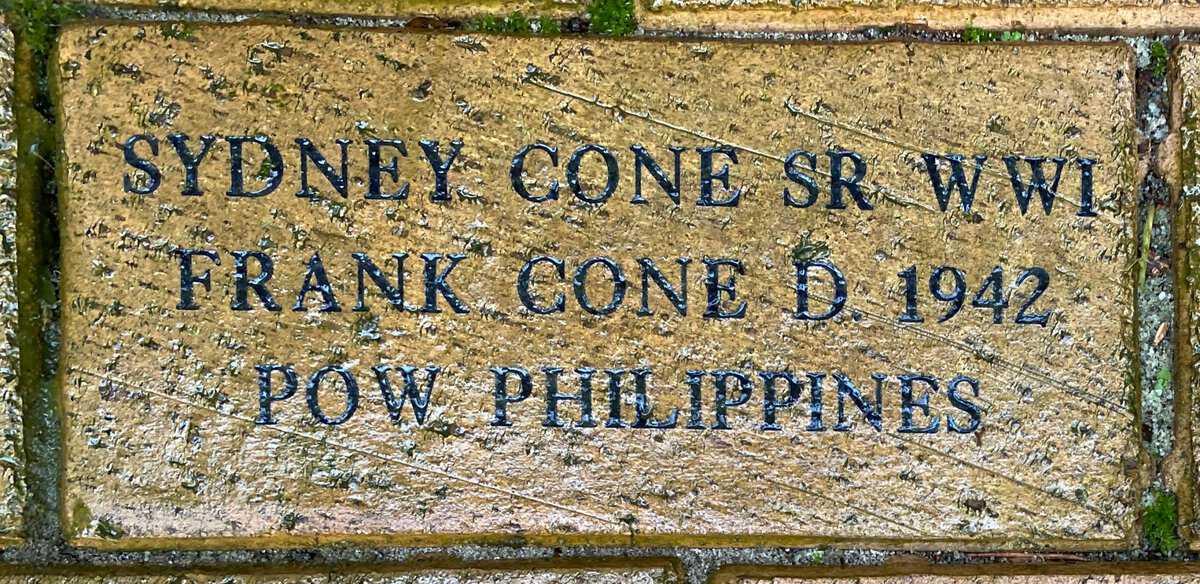
SYDNEY CONE SR WWI
FRANK CONE D. 1942
POW PHILIPPINES
FRANK CONE D. 1942
POW PHILIPPINES
Section: 2
Row: 5
Service Branch, Rank
Army
CAPT.
Theater(s) / Campaign(s) / Operations(s)
Philippines
Period of Service
1939-1942
Biography
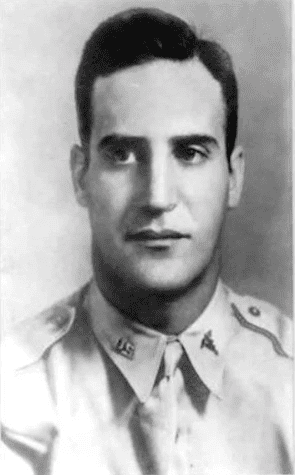
Frank Cone was born on June 24, 1910, in Pikesville, Maryland, a community near Baltimore during a period of rapid urban and institutional growth.
Cone pursued higher education at Johns Hopkins University, one of the most respected medical institutions in the United States. There, he earned both a Bachelor of Science in Business Administration (BSBA) and a Doctor of Medicine (MD). Completing dual degrees placed him among a relatively small group of highly trained physicians of his era and reflected both intellectual ability and discipline. His medical education occurred at a time when Johns Hopkins was internationally recognized for its emphasis on scientific rigor and modern clinical training, shaping Cone into a well prepared physician before his entry into military service.
After completing medical school in 1938, Cone began preparing for a civilian medical career. He was in the process of starting a medical practice in Houston, Texas, a city experiencing rapid growth and increasing healthcare demand. This phase of his life, however, was brief.
As international tensions escalated and war expanded in Europe, Cone received notice in 1939 “requesting” his service with the U.S. Army Medical Corps. He was soon assigned to overseas duty, eventually serving in the Philippines, arriving via a luxury liner.
By December 1941, Japanese forces launched coordinated attacks across the Pacific following the strike on Pearl Harbor. American and Filipino troops in the Philippines were forced into a desperate defensive campaign, retreating to the Bataan Peninsula. Cone served there as a medical officer during the Battle of Bataan, one of the most grueling engagements of the early Pacific War.
Medical conditions on Bataan were dire. Cone and other Army doctors worked with severely limited supplies, constant aerial and artillery bombardment, widespread tropical disease, and thousands of wounded soldiers. Field hospitals were often improvised and positioned close to combat zones. Despite these hardships, Cone continued to treat both American and Filipino troops, performing emergency medical care under circumstances that tested physical endurance and professional resolve.
On April 9, 1942, Allied forces on Bataan surrendered to Japanese troops. Cone was captured along with approximately 75,000 American and Filipino soldiers, marking one of the largest mass surrenders in U.S. military history.
Following surrender, Cone was subjected to the infamous Bataan Death March, a forced march of roughly 65 miles conducted in extreme heat with minimal food or water. He was soon transferred to Camp Cabanatuan, where he and other prisoners suffered from malnutrition, disease, and lack of medical care, leading to the deaths of thousands. Medical personnel like Cone often continued to care for fellow prisoners despite facing the same starvation and illness themselves. He was reported by his fellow soldiers as always looking after the others, as they said, “helping, helping, helping. “
Frank became very ill while in captivity and was diagnosed by another physician has having intestinal cancer. Knowing he was going to die, he gave all his personal effects - his watch, a fountain, pen, a pencil, and a pearl he acquired in the earlier stages of the war and intended to have set in a piece of jewelry for his wife. Remarkably, these items survived the war and were given to his family.
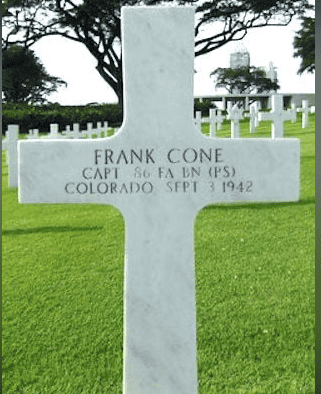
Captain Frank Cone died at the age of 32 on September 3, 1942. He was buried in a common grave in the camp. He was eventually buried in the Middle American Cemetery and Memorial, one of 29 such American battle monuments or memorials around the world. His life stands as a testament to the role of military physicians who served not only as healers but as symbols of resilience and humanity amid war.
Medals / Awards / Recognitions
Bronze Star
Additional Photos